The Day the Wagyu World Tilted: Reflections on the AWA AGM, WBVs, Helical and the Next Frontier
Updated: Nov 26, 2025

Yesterday’s AWA Workshop and AGM will go down as one of those rare moments where you can feel the gears of an entire global industry shift. A quiet tremor that, over time, becomes the kind of story people lean back in their chairs to tell: “Remember back when we used EBVs?”
I walked into the AGM completely unaware of what was about to be announced. I had been travelling, blissfully ignorant that an email had been sent to the membership earlier that day outlining sweeping changes. Based on the number of phone calls I’ve fielded since, everything from “What does this mean for us?” to “Will my cows be okay?”
I was not alone.
And that is exactly why this article needed to be written.
Because yesterday was monumental.
Not just for Australia.
Not just for the AWA, but for the global Wagyu ecosystem.
As with anything, people do not like change. And yesterday delivered more change in one sitting than the breed has seen in decades.
Yet, for those of us who care deeply about this breed, its flavour profile, its maternal lines, its oleic acid story, its genomic truth — yesterday was also validation.
And yes, for those wondering: I still maintain that EBVs have always had merit if the data is clean, unmanipulated, and grounded in lifetime and carcass performance. My critique was never about the tool, it was always about the data going into it.
WBVs change that dynamic entirely.
This is a system built specifically for Wagyu.
By Wagyu people.
Using Wagyu data.
Feeding into a Wagyu-only evaluation pipeline.
Yesterday marked the moment we stopped being a passenger in multi-breed models and took the wheel back.
1. The Unspoken Tension: Anticipation, Anxiousness and a Room Holding Its Breath
The atmosphere in the room was electric — but not in a loud way.More like the quiet hum before a storm or the nervous shifting of weight when everyone knows a turning point is coming.
You could feel:
Curiosity
Hope
Suspicion
Protectiveness
Pride
Fear of the unknown
And, most of all, you could feel the AWA’s own awareness of how big this moment was.
They knew the membership would be anxious.
They knew people would be confused.
They knew some breeders would walk out excited, and others would walk out needing to lie down in a dark room.
The rollout was delivered confidently, but there was no mistaking the watchful eyes scanning the audience, checking body language, waiting to see whether the message landed.
Because what was unveiled yesterday was not a small tweak.
It was a reinvention of the genetic backbone of the Australian Wagyu breed.
2. The Membership’s Questions: Brave, Direct and Necessary
Among the voices that cut through the silence with clarity was Joe Grose of 3D Genetics.
Anyone who knows Joe knows he is measured, articulate, and deeply respected. When he speaks, the room listens, which is exactly what happened yesterday.
Joe raised the questions everyone was thinking:
How do we nominate animals for the 2026 Elite Sale when EBVs will be obsolete by then?
Will WBVs completely reshape the rankings of animals bred and marketed for generations under EBV-driven metrics?
How will the industry reconcile the changeover?
Will some herds experience sudden re-ranking through no fault of their breeding program?
His delivery wasn’t confrontational.
It was calm, thoughtful and precise.
It acknowledged the enormity of the shift without resisting it.
And this is the part that matters: His questions were not for himself. They were for the industry.
Joe’s contribution helped anchor the room, and the Association recognised that seriousness in their response.
3. The Elephant in the Room: The Ghost of the SRI–BFI Transition
Let’s be honest.
The last time the Association changed the metrics, when the SRI was sunset and replaced by the BFI, the reaction from the membership bordered on chaotic.
Breeders saw years of marketing, sale results and sire positioning shift overnight.
Some animals skyrocketed. Others crashed. Buyers and sellers scrambled to re-evaluate what was “good,” “elite,” or “sale worthy.”
And that history hung in the room yesterday like an unspoken reminder.
This time, however, the shift is not cosmetic.
It is structural.
It is scientific.
It is purpose-built.
It is Wagyu only.
WBVs are not a rebrand.
They are a rebuild.
But understandably, the membership needed reassurance, and the workshop and AGM did not shy away from those conversations.
4. The Scientific Core of WBVs: What Makes Them Different
Let’s break this down clearly.
For years, Wagyu breeders have relied on a data system designed for multi-breed comparison. Although Breedplan has provided some benefits to the industry, it was not specifically tailored for the unique characteristics of Wagyu cattle. Here are some key differences:
Wagyu-Specific Characteristics
Slower growth rate
Distinct marbling biology
Metabolic efficiency
Oleic acid pathways
Carcass flavor chemistry
Extended feeding durations
Strong maternal influence
WBVs (Wagyu Breeding Values) completely change this landscape.
Advantages of WBVs
The parameters are exclusively tailored for Wagyu.
The trait correlations are based solely on Wagyu performance.
The model architecture aligns with Wagyu’s unique biology.
Genomic inbreeding is assessed at the molecular level.
Carcass and feed intake data are directly integrated into the system.
No multi-breed dilution affects the data.
No cross-breed inflation distorts the results.
There is no reliance on outdated trait heritabilities.
Data cleaning is rigorous, informed by members, and transparent.
This is the first system that truly understands Wagyu for what it is, without comparison to other breeds.
5. The Helical Database: Quietly One of the Most Transformative Pieces of the Day
Helical is the new brain of the breed.
I cannot overstate how significant it is that we now have:
A fully controlled Wagyu database
Centralised DNA workflows
Automated pipelines
Real-time genetic evaluation triggers
Integrated trait development
Streamlined member submissions
Fewer forms
Cleaner data flows
The ability to scale research at speed
Helical is not just a database
It is the infrastructure that makes WBVs possible.
Without it, WBVs would just be a hope.
With it, WBVs become an international benchmark.
6. Milk and EMA: Finally Some Science That Matches Reality
This was the part of the day where heads started nodding.
Breeders leaned in. Pens stopped moving. This was the validation moment.
Milk EBVs have frustrated breeders for years.
Why?
Because the trait behaviour in the real world never aligned with the numbers.
Under Breedplan:
Milk was treated almost independently
Genetic correlations were near zero
Heritability was overestimated
Model architecture forced the trait into isolation
Real performance was not reflected in EBVs
Under WBVs:
Milk now expresses strong correlations with growth
Maternal genetic components are better separated from environmental ones
Heritability reflects real-world biology
The model mathematically aligns with how milk actually contributes to calf performance
For those of us who have spent years watching calves, weights, udders and performance in paddocks — this was the moment where science finally caught up with reality.
EMA was the same story.
Breedplan’s parameters simply did not reflect Wagyu biology.
EMA should correlate strongly with:
Carcass weight
Feed intake
Growth trajectory
Ribeye development
Under WBVs, it finally does.
This was the section of the day that demonstrated the power of a Wagyu-only genetic system.
7. Oleic Acid and Fineness: The Turn Toward Flavour and Function
This was the part that made me smile.
For years I have talked about:
Flavour profile
Maternal influence
Oleic acid
Fineness
The Japanese foundations of eating quality
The relationship between intramuscular adipogenesis and metabolic efficiency
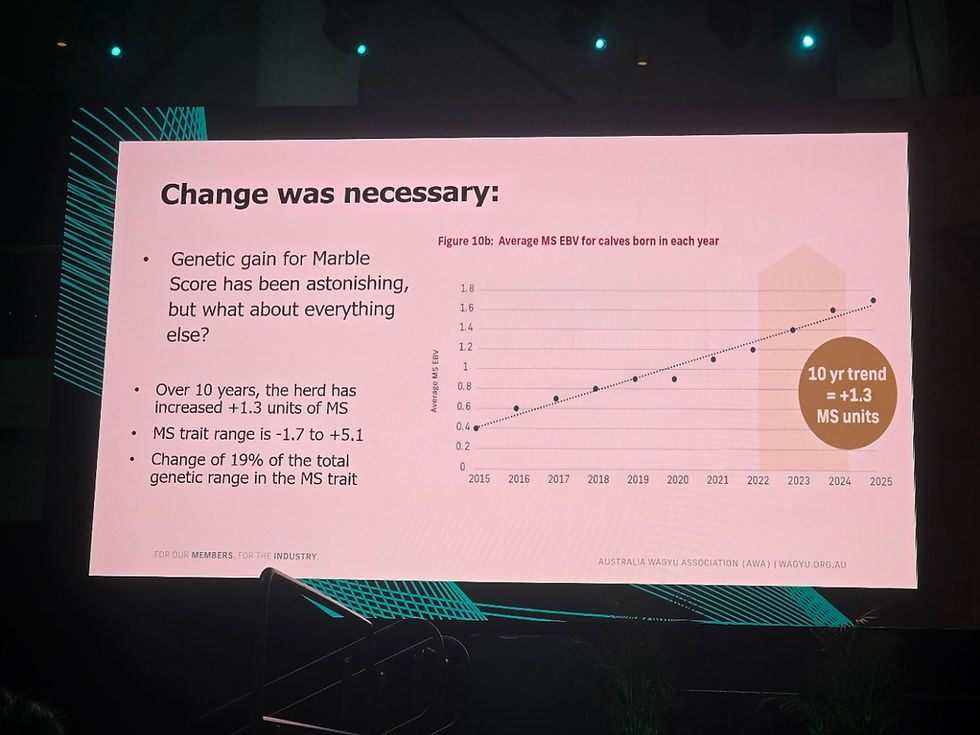
And finally, the Association is steering the scientific gaze away from just “marble score” and toward the chemistry that actually sets Wagyu apart.
The upcoming WBV for Fineness Index, supported by ribeye modelling and laboratory validation and it is enormous.
The discussion around oleic acid was equally promising, marking the first time the Association acknowledged these traits as central pillars, not fringe add-ons.
This is the future of premium beef.
This is what the global market wants.
And now the science is beginning to reflect it.
8. Feed Intake, Net Feed Efficiency and Genetic Energy Profiles
The Association revealed they now have:
Over 2000 net feed intake records
Across roughly 100 sires
With the capacity to evaluate new feed efficiency traits
For Wagyu, a breed that spends up to 700 days on feed, this is not a minor development.
This is the gateway to:
Identifying efficient converters
Reducing emissions
Improving profitability
Increasing carcass yield
Enhancing sustainable production
Tying feed intake to flavour development
Refining maternal efficiency
It is also the missing scientific link the breed has needed for years.
This will become one of the most commercially important WBVs in the next decade.
9. Genetic Defects: The Pipeline We Needed Years Ago
This section was delivered with clarity and seriousness.
The new testing on:
A10
HFSD
Brachygnathia
… demonstrates a level of scientific rigour and future-proofing that the global Wagyu market absolutely demands.
This is not just about identifying defects.
It is about protecting bloodlines.
Protecting markets.
Protecting reputations.
And protecting breeders who rely on the integrity of genetics they invest in.
It was handled transparently, respectfully, and with sound scientific direction.
10. The Progeny Test Program: Quietly Becoming the Crown Jewel
The depth of data now flowing from the progeny test program is extraordinary:
Thousands of calves
Multiple cohorts
Multiple environments
Dedicated contributor herds
Extensive carcass records
Real-time growth
Side-by-side sire comparisons
Maternal line evaluation
Feedlot tracking
This is the most powerful long-term dataset the Australian Wagyu breed has ever had access to.
And now that WBVs sit on top of this pipeline?
We are entering the most data-rich decade in Wagyu history.
Final Reflection: The Beginning of the Next Era
In years to come, we will sit around boardrooms, auctions and ranch tables saying: “Remember back when we used EBVs?”
Not dismissively.
Not mockingly.
But with the fondness of people who were there when the tide turned.
WBVs do not erase the past.
They honour it.
They refine it.
They elevate it.
And yesterday, the Australian Wagyu Association stepped onto a global stage with a scientific backbone strong enough to carry the breed into the next 20 years.
To the Association — congratulations.
To the membership — your anxiousness is valid.
To the global industry — buckle up.
To the data — welcome home.
And to the future of Wagyu — I am all in.
Warmest Wagyu Wishes,


Comments