WagyuEdge 2026 — Day 1: A Compass Without Direction
Jessie Chiconi | 4C Consultancy
A more accurate compass does not solve a navigation problem if there is no agreement on where the industry is heading.
One of the most important phrases I've heard in the beef industry on a global scale is, "The beef industry is about eating it" - Peter Hughes.
That was the underlying tension sitting beneath the opening day of WagyuEdge 2026. While the focus was centered on advancements in genetic evaluation, the broader implication was not simply that the industry has improved how it measures cattle, but that it is still working to define how those measurements should be applied.
The session Innovation in Action: AWA Technical Highlights, led by Matt McDonagh, Vinzent Boerner and Professor Daniel Garrick, introduced the transition to Wagyu Breeding Values as a significant step forward. The move toward a Wagyu-specific, genomically integrated model, supported by expanded carcass data, was presented as a system that more accurately reflects biological relationships within the population. As Professor Garrick outlined, the strength of the model lies in its ability to utilise a far broader dataset and better represent how traits interact within Wagyu cattle.
From a technical standpoint, this represents meaningful progress.
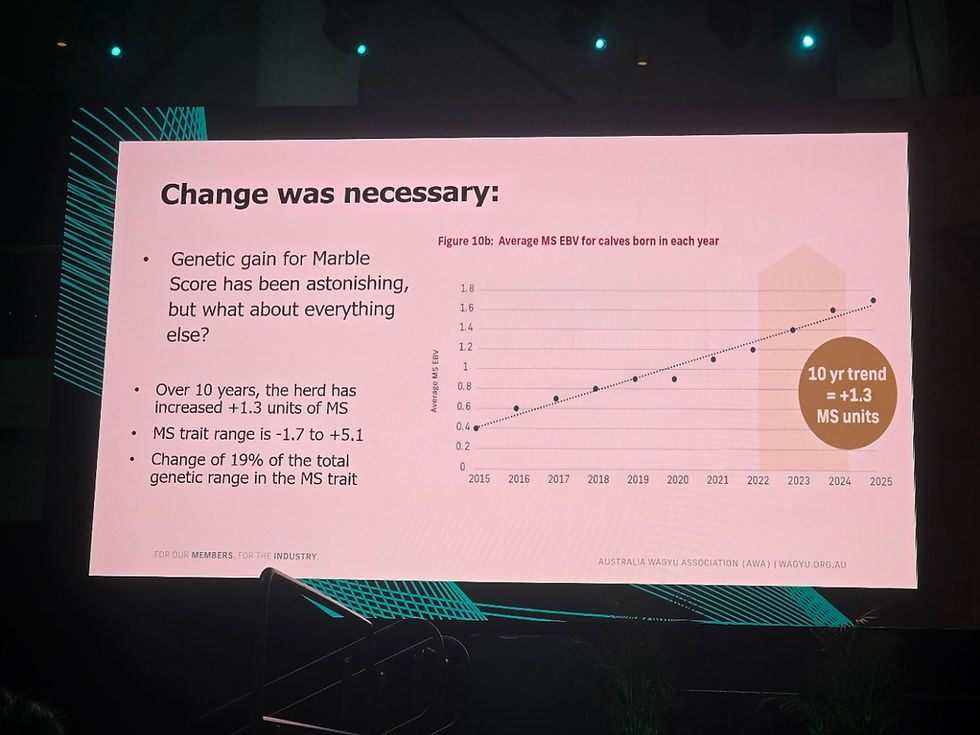
However, as the session progressed, the focus shifted from what the system can measure to what it has been used to prioritise. Genetic trend data presented during the session highlighted substantial gains in marble score over the past decade, contrasted against comparatively limited movement in carcass weight and other production traits. The observation made on stage that “we’ve made massive change in marble score… much less in carcass weight… that’s bugger all” reflected a reality that is difficult to ignore.
The industry has not lacked progress. It has directed it.
This distinction is critical, because it reinforces the role of evaluation systems within production. Breeding values, including WBVs, do not determine direction. They respond to it. They describe where animals sit within a model, but they do not define the objectives that sit above that model.
In this context, WBVs can be understood as a more precise compass. They provide improved clarity on position and enhance the industry’s ability to compare animals within a population. What they do not provide is direction. Without a clearly defined production objective, the presence of a more accurate system simply confirms where selection has been applied, rather than guiding where it should move next.
This relationship between measurement and application became more apparent as the broader Day 1 program unfolded. In The Big Picture: Risks and Realities, Julie Collins, Samantha Allan and Ross Ainsworth outlined the external pressures shaping agricultural production, including supply chain constraints, input costs and global trade dynamics. These factors do not sit outside genetic selection; they directly influence it. Similarly, State of Origin: Feeding the Future, with Charlie Mort, Scott Minnikin and Geoff Cornford, reinforced the variability of production environments and the role that feed systems play in determining performance.
Taken together, these sessions highlighted a critical point. The performance of an animal is not defined solely by its genetic profile. It is the result of the interaction between genetics, environment and management. Any evaluation system, no matter how advanced, captures only part of that equation.
This was further reinforced through the statement made during the conference that “in the age of genomics, phenotype is king.” While the industry continues to invest heavily in data and modelling, this comment served as a reminder that all evaluation remains anchored to the physical expression of the animal.
It was, however, the outcomes of the Branded Beef Competition that brought this discussion into sharp focus.
The Class One Fullblood Wagyu winner, Marble King Wagyu, delivered the highest eating quality outcome within its category. That result stands on its own merit. Yet when attempting to reconcile that outcome back through the same system that is now being positioned as the industry standard, that alignment is not immediately visible. The animal is not readily traceable within the association’s database in a way that allows for direct correlation to pedigree or WBV profile.

In contrast, the Reserve Champion, Mayura Signature Series, provides a clear and measurable reference point. The steer behind this entry can be identified, its pedigree verified, and its WBVs assessed. This level of transparency allows for benchmarking and interpretation, and is consistent with Mayura’s long-standing approach to submitting comprehensive carcass data and lifetime performance records.
The distinction between these two outcomes is not a question of quality. It is a question of visibility, and more broadly, alignment between system and outcome.


This becomes more complex when considering the genetic influence behind the Reserve Champion. The steer is sired by Mayura Notorious, a bull with an extensive carcass data record and a proven history of performance across multiple branded beef competitions. Notorious has contributed to Grand Champion and Reserve Champion outcomes on more than one occasion, across different females and environments.
What is particularly relevant is that this level of performance has been achieved from a sire whose marble score sits only marginally above breed average.
This is not an anomaly.
It is a signal.
Because it challenges a central assumption currently underpinning much of the industry discourse, that higher index values, particularly for marble score, will consistently correlate with superior eating quality outcomes.
The performance of Notorious suggests otherwise. It demonstrates that consistency of outcome, across multiple progeny groups and production systems, may not be fully captured within a single trait or index value. It highlights the influence of factors such as maternal contribution, data depth, environmental interaction and overall program design.
When viewed through this lens, the role of WBVs becomes clearer. They are an increasingly accurate tool for describing genetic potential, but they do not encapsulate the entirety of what drives eating quality or commercial success.
This brings the discussion back to transparency and industry responsibility.
If WBVs are to be adopted as the standard framework for evaluation, then there must be clear and consistent alignment between those values and the outcomes being recognised at the highest level of the industry. The ability to access, interpret and correlate genetic data for competition winning animals should not require investigation. It should be inherent to the system.
Without that level of transparency, the system remains partially disconnected from its most important reference point.
A recalibrated compass is valuable. It improves accuracy and strengthens decision making. But its value is dependent on two things. First, that there is a clear understanding of direction. And second, that the reference points used to validate that direction are visible and consistent.
By the conclusion of Day 1, it was evident that the industry has made significant progress in how it measures cattle. The tools are more advanced, the data more extensive, and the systems more refined.
What remains less certain is how that measurement is being translated into consistent, aligned outcomes.
Until that is resolved, the industry will continue to improve its ability to describe position, without necessarily strengthening its ability to determine direction.... and we're not even scratching the surface!
Jessie Chiconi
4C Consultancy
Interpreting data, exposing structural weaknesses, and applying perspective grounded in quantitative analysis to ensure the long term success of the Wagyu breed on a global scale.
Part Two to follow — work resumes post elbow surgery!


Comments