WagyuEdge 2026 — Day 3: The Elephant in the room and why the Industry Needs to Pay Attention
Jessie Chiconi | 4C Consultancy
By the time Day 3 arrived, the conversation had finally moved beyond where animals sit on paper and toward the far more uncomfortable question of whether the industry is actually producing what it believes it is producing.

For an industry becoming increasingly obsessed with prediction, the ability to objectively measure actual outcome is going to change the game completely.
For me, this was arguably the most important day of the entire conference, because the discussions surrounding emerging technologies, particularly 3D carcase imaging and objective carcase assessment, have the potential to fundamentally change the way the Wagyu industry validates performance moving forward. Up until now, much of the industry has operated within systems designed to predict outcome. Increasingly sophisticated genomic evaluation, larger datasets and the transition toward WBVs have all improved our ability to estimate genetic potential within a population, and that progress is real. It should be acknowledged as such.
However, prediction and realised performance are not the same thing, and I think parts of the industry are beginning to blur that distinction far too comfortably.
What technologies such as 3D carcase imaging introduce is a far more direct and objective way of assessing the final product itself. Rather than relying heavily on individual proxy traits or selective measurements, the industry is moving toward systems capable of evaluating the entire composition of the carcase, including muscle distribution, fat deposition and overall yield, in a far more comprehensive and repeatable manner. That changes the conversation significantly, because it shifts the point of validation away from theoretical expectation and back toward measurable commercial outcome.
And honestly, I do not think the industry fully appreciates the significance of that yet.

For an industry built so heavily around prediction, the ability to objectively measure actual commercial outcome at scale has enormous implications moving forward, not just for Wagyu, but for the entire global beef industry.
For an industry built so heavily around prediction, the ability to objectively measure actual commercial outcome at scale has enormous implications moving forward, not just for Wagyu, but for the entire global beef industry.
For years, we have become increasingly confident in our ability to describe cattle through numbers. Breeding values, percentile rankings and indices have become central to how animals are marketed, interpreted and discussed, to the point where in some circles the figures themselves have almost started to replace the cattle. What concerns me is not the existence of these systems, because they absolutely have value when used correctly, but the growing tendency to speak about predictive figures as though they are the realised trait itself.
They are not.
A marble score WBV is not actual marble score. An EMA WBV is not actual eye muscle area. They are predictive assessments generated within a model designed to estimate genetic potential relative to a reference population. They are tools intended to support breeding decisions, not substitutes for commercially validated outcome.
That distinction matters enormously, particularly as the industry continues narrowing conversations around individual metrics while simultaneously operating within increasingly complex production environments and increasingly demanding global markets.
The reality is that no amount of genomic sophistication changes the fact that the animal still has to function biologically and perform commercially. It still has to breed efficiently, remain structurally sound, convert feed effectively and ultimately produce a carcase capable of delivering a consistent eating experience. Those things are not secondary to the model. They are the biological mechanisms through which the model is expressed.
This is why the comment raised earlier in the conference that “in the age of genomics, phenotype is king” resonated so strongly with me, because underneath all the data, the algorithms and the recalibrated systems, the phenotype remains the point where theory either holds together or falls apart.
What concerns me most moving forward is not the existence of WBVs or any other form of genetic evaluation, because these systems absolutely have value when used correctly. What concerns me is the point at which an industry begins underpinning its entire identity around estimated values and predictive figures, because historically, across multiple breeds and multiple associations, that has almost always preceded imbalance.
That observation is not coming from theory. It is coming from watching it happen repeatedly over time.

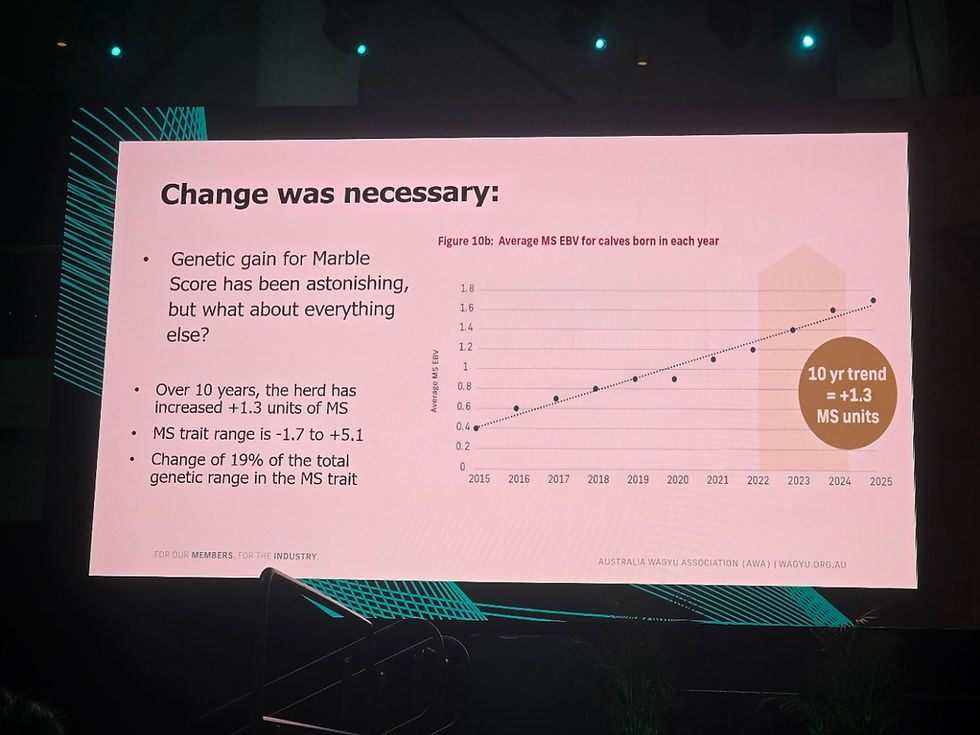
As a sixth generation cattle producer who has spent time across multiple breed societies and production systems, one of the clearest patterns I have seen is that whenever the emphasis shifts too heavily toward estimated figures themselves, rather than the broader production system those figures are meant to support, the breed inevitably begins to narrow. Initially it appears as progress because the numbers move quickly, selection pressure intensifies and the industry becomes highly focused on measurable gain. But over time, the unintended consequences begin surfacing elsewhere.
Phenotype weakens. Fertility declines. Structural integrity softens. Feed efficiency becomes inconsistent. Maternal strength loses priority. Eventually the breed stops functioning as a balanced biological system and instead becomes a population heavily optimised around whichever metrics are currently receiving the greatest commercial or marketing emphasis.
And that is where the real danger sits.
Because breeding values, regardless of whether they are called WBVs, EBVs or EPDs, were never designed to become the product themselves. They were designed to support decision making within breeding programs. They are tools intended to help producers align cattle with operational objectives, whether that be terminal performance, maternal strength, feed efficiency, carcase quality or broader commercial balance.
But what so often happens within breed societies is that the figures gradually stop being used purely for breeding decisions and begin transitioning into marketing tools. Once that occurs, selection pressure changes dramatically because breeders no longer select solely for operational outcome. They begin selecting for market perception within the seedstock system itself.
That distinction matters enormously.
Because once estimated values become the dominant marketing currency of a breed, the risk is that the breed starts breeding toward the algorithm rather than toward the animal, the production system or ultimately the consumer. At that point, the numbers may continue improving while the broader biological and commercial balance of the breed quietly deteriorates underneath them.
And the reality is that those consequences are rarely corrected quickly.
When imbalance enters a breed, particularly through sustained narrow selection pressure, it can take decades to recover from. The very systems designed to accelerate progress can, if misapplied, accelerate regression just as efficiently.
The other reality that I believe the industry needs to be mature enough to discuss openly is the integrity and completeness of the data itself, because regardless of how sophisticated any genetic evaluation system becomes, it remains entirely dependent on the information being submitted into it.
And this is where human nature inevitably enters the equation.
In an ideal world, every piece of lifetime performance data, every carcase result and every production outcome would be submitted completely, consistently and honestly across the entire membership base. If that occurred uniformly across the breed, the industry would have an extraordinarily powerful benchmarking system capable of identifying genuine genetic trends and commercially relevant outcomes with a very high degree of accuracy.
But realistically, that is not the environment any breed society operates within.
Whenever estimated values begin carrying significant commercial influence, whether that be WBVs, EBVs, EPDs or any other predictive framework, there also becomes an incentive to selectively manage the information feeding those systems. Sometimes that occurs intentionally. Sometimes it occurs through omission, inconsistency or simple human bias toward highlighting favourable outcomes over unfavourable ones.
Either way, the effect is the same.
The benchmark itself becomes less complete and once incomplete or selectively submitted data begins influencing a predictive model, the industry is no longer measuring a perfectly representative population. It is measuring the population that has been presented to the system.
That distinction is incredibly important.
Because people often speak about breeding values as though they are objective truth, when in reality they are statistical estimates built upon available information. The stronger, broader and more transparent the dataset, the stronger the prediction becomes. But the inverse is also true. If data is selectively submitted, inconsistently reported or strategically managed, then the predictive strength of the model becomes increasingly vulnerable to distortion.
That is not a criticism of the science, it is simply the reality of any system reliant on human participation.
And unfortunately, history across multiple breeds has shown that whenever estimated figures begin carrying too much marketing weight, the pressure to produce favourable numbers can gradually begin influencing behaviour around data itself. That is where industries need to be extremely careful, because once the focus shifts from honestly measuring performance to strategically presenting performance, the system slowly begins losing the very integrity it was designed to create.
This is precisely why objective technologies such as large scale carcase imaging and whole system validation are so important moving forward. The closer the industry moves toward complete, transparent and commercially verified outcome measurement, the less room there is for selective interpretation and the stronger the benchmarking process becomes for everybody involved.
Because ultimately, the purpose of these systems should not be to create the most marketable figures, it should be to create the most accurate understanding possible of what genuinely performs.
And perhaps that is the real crossroads the Wagyu industry now finds itself standing at.
Not whether genomic evaluation should exist, because it absolutely should. Not whether technology should continue advancing, because it absolutely must. But whether the industry can maintain enough perspective to ensure that the tools designed to support the breed do not eventually begin defining it.
Because after all the algorithms, rankings, genomic evaluations and market projections are stripped away, the outcome still comes back to something remarkably simple.
As the very wise and respected cattleman, Mr. Peter Hughes once said, "The beef industry is about eating it".
Ladies and Gentlemen, it is time to focus on the full picture, not just the figures.

Jessie Chiconi
4C Consultancy
Interpreting, analysing and, where required, challenging the systems that underpin this industry, ensuring progress is driven by perspective, data and measurable outcome.


Comments